


6 Powerful Insights into Mindfulness, Brain & Spirituality — How Consciousness Shapes Our Choices and Freedom
Introduction
Human behaviour is shaped by biology, environment, and conscious choice. While our brain and surroundings influence us, it is our awareness, reasoning, and values that allow us to take responsibility and shape our lives.
This blog explores six key insights into how mindfulness connects the mind, brain, and spirituality, showing how conscious thought, moral reasoning, and self-awareness empower us to manage our behaviour, transform habits, and live with purpose. The video link is found at the end of the article.
Read on to explore 6 Powerful Insights into Mindfulness, Brain & Spirituality — How Consciousness Shapes Our Choices and Freedom.

1. Are We Our Mind or Our Body?
Are we our mind or our body? Human behaviour is influenced by biology, environment, and conscious choice, yet understanding how these interact is essential to personal development.
While biological determinism suggests that our genes and physical makeup largely determine who we are, this perspective overlooks a critical dimension of human life—our consciousness.
When we ignore this, we risk diminishing personal responsibility and underestimating the power of values, ideals, and moral commitment in shaping our lives.
2. Beyond Biology — The Role of Conscious Choice
Biology and environment undeniably influence us—our brain produces automatic responses such as hunger, fear, and emotional reactions, while our upbringing and surroundings shape behaviour patterns. However, to assume that we are simply products of these forces is to ignore the role of the conscious mind—the part of us that can reflect, choose, and act with intention.
Great leaders throughout history demonstrate that moral conviction, rather than instinct or social pressure, can drive profound change.
Without recognising this, we may fall into the trap of excusing our behaviour as “just how we are wired,” rather than taking responsibility for our actions.

3. Understanding Consciousness — The Central Question
Understanding the relationship between mind, consciousness, and body remains one of the most complex challenges in science.
Consciousness—our awareness, thoughts, and inner experiences—is central to what makes us human, yet there is no single explanation for how it works. This raises important questions: Are we defined by our physical impulses, or by our capacity to think and reason?
Is free will an illusion, or do we have genuine control over our actions?
4. Three Perspectives — Biology, Consciousness, and a Holistic View
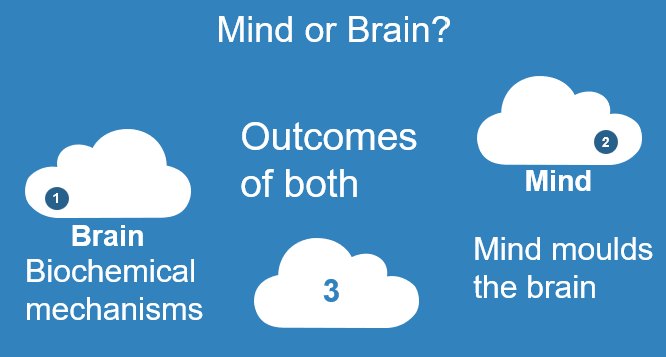
Three key perspectives offer insight into this question. Biological determinism views the brain as a machine, where behaviour is driven by physiological processes and automatic responses. The science of consciousness, by contrast, highlights the role of subjective experience—our ability to think, feel, and make decisions that can override biological impulses. A third, holistic perspective suggests that mind and body are not separate but continuously interact and influence each other.
Reductionism attempts to understand complex systems by breaking them down into their simplest parts, such as explaining human behaviour purely through brain chemistry or neural activity.
While this approach has provided valuable insights, it often fails to explain the richness of human experience. Knowing which areas of the brain are active during an experience does not explain what that experience feels like.
As many philosophers and scientists argue, the “whole is greater than the sum of its parts,” and consciousness cannot be fully understood by examining physical processes alone.
5. The Power of Consciousness — Shaping Behaviour and Perception
The limitations of a purely biological explanation become clear when we consider the “hard problem” of consciousness—why physical brain activity gives rise to subjective experience at all. While science can map neural activity, it cannot fully explain emotions, meaning, or the inner sense of self.
This highlights the importance of integrating both objective scientific understanding and subjective human experience.
In contrast, the science of human consciousness emphasises our ability to reason, reflect, and make moral decisions. This perspective recognises that human development is not only shaped by biology, but also by our inner life—our thoughts, beliefs, and values.
Viktor Frankl’s reflections from his time in a concentration camp powerfully illustrate this point. Even in extreme suffering, he observed that individuals retained the freedom to choose their response, demonstrating that human beings are not entirely controlled by their circumstances.
Our perception of reality is also shaped by our consciousness. While our senses provide information about the world, they do not always present a complete or accurate picture. Our minds interpret and filter this information, influenced by past experiences, emotions, and beliefs. This means that what we perceive is not always objective reality, but a constructed interpretation. Conscious reasoning allows us to step back, question our assumptions, and refine our understanding.
Through reasoning, we can regulate instinctive impulses such as anger, fear, or desire, choosing responses that align with our values rather than reacting automatically. This ability to pause, reflect, and act intentionally is a key aspect of mindfulness and self-management.
It demonstrates that our conscious mind plays an active role in shaping behaviour, rather than being a passive by-product of biology.
6. Transforming the Brain — Growth, Learning and Free Will
Neuroscience further supports this understanding through the concept of brain plasticity. The brain is not fixed; it is constantly changing in response to experience, learning, and intentional practice. Repeated thoughts and behaviours create new neural pathways, meaning that we actively shape our brains over time.
Positive emotions, for example, enhance brain function by improving connectivity, increasing motivation, and reducing stress. Similarly, practices such as reflection, goal setting, and self-regulation strengthen cognitive control and support personal growth.
Research also shows that psychological and emotional factors can influence physical experiences. In cases of psychogenic pain, unresolved emotional trauma can manifest as physical symptoms, demonstrating the deep connection between mind and body.
This further highlights the importance of conscious awareness and reasoning in understanding and addressing human experience.
Education plays a crucial role in developing this capacity. While genetic predispositions may influence certain abilities, learning and experience enable individuals to reach their full potential. Cognitive functions such as attention, memory, and reasoning are developed through practice, reinforcing the idea that human beings are not limited by biology alone.
Moral reasoning is another essential aspect of human development. Our emotions are often shaped by prior reflection on what is right or wrong. For example, feelings of guilt or empathy arise from an underlying understanding of moral values.
This shows that ethical behaviour is not purely instinctive but is guided by conscious thought and reasoning.
Conclusion
Ultimately, human beings are not merely biological organisms—we are conscious, reasoning individuals capable of shaping our lives. While biology and environment influence us, they do not fully determine us.
Through mindfulness, reflection, and moral awareness, we can manage our thoughts, regulate our behaviour, and pursue ideals that give meaning and direction to our lives.
In recognising the power of consciousness, we affirm that we are not simply reacting to the world—we are active participants in shaping it.
Watch the blog video here: https://www.youtube.com/watch?v=qw9G_UCEddk
Videos and Framework created by Dr John Bellavance
Global Vice President, Sun Moon University
Asia Pacific Coordinator, International Association of Academicians for Peace
Vice-President, Universal Peace Federation Australia


